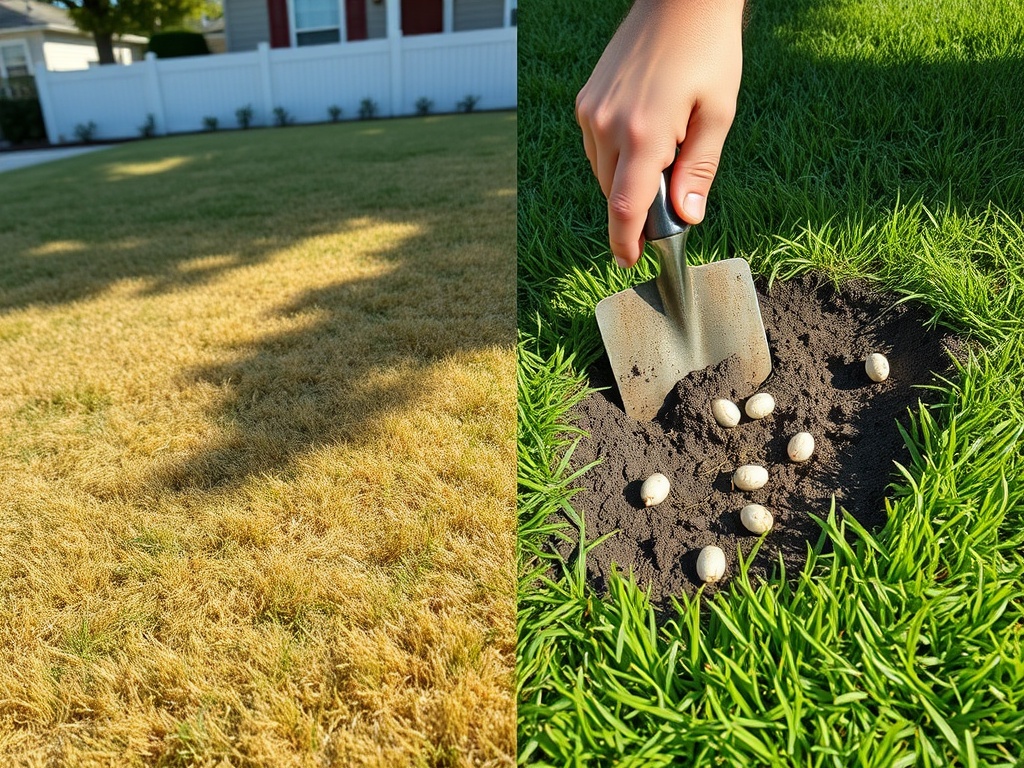
A brown lawn does not automatically mean drought, and it does not automatically mean grubs. The fastest way to tell the difference is to combine the damage pattern with a simple turf-lift test, soil-moisture check, and a look for root loss or actual larvae before choosing a treatment.
TL;DR: Drought stress usually affects exposed or broadly dry areas and leaves roots attached, while serious grub feeding often creates irregular dead patches with weakened roots that let sod lift unusually easily. Confirm the cause before watering heavily or applying insecticide.
Why These Two Lawn Problems Are Easy to Confuse
Both drought and root-feeding grubs can leave turf tan and thin, and they can occur together. Color alone is therefore a poor diagnosis.
Penn State Extension’s white grub guidance notes that severe root feeding can make sod feel spongy and easy to roll back, while University of Minnesota guidance describes drought stress as broader browning after extended heat and limited moisture. Local grass type, soil, shade, irrigation, and weather can change the pattern.
If watering has been uneven or restricted, review water-saving habits for home landscapes before increasing irrigation everywhere.
Start With the Damage Pattern
Stand back and look at the whole lawn before digging.
Clues that lean toward drought
Drought stress often follows exposure. Sunny slopes, shallow soil, areas near pavement, and places that receive less irrigation may brown first. In cool-season lawns, the browning may be relatively widespread rather than appearing as small islands of dead turf. Some grass may be dormant rather than dead, especially if crowns and roots remain alive.
Walk across the area and compare it with greener sections. If the soil is hard and dry several inches down, the lawn has been receiving little effective moisture, and the roots remain anchored, drought becomes more likely.
Clues that lean toward grub injury
Grub damage is more suspicious when patches feel loose or spongy and the grass separates from the soil because roots have been eaten. Birds, skunks, raccoons, or other animals digging repeatedly in the same area can be another clue because they may be searching for larvae. Animal digging by itself is not proof, however, because lawns contain earthworms and other prey too.
Penn State Extension recommends physically sampling turf and soil rather than treating based on appearance alone. That principle matters because brown patches can also come from disease, compaction, pet urine, poor irrigation coverage, chinch bugs, billbugs, construction debris, or other stresses.
Do a Simple Three-Part Diagnostic Check
You do not need specialized equipment for an initial inspection. A spade or trowel and a simple soil-moisture check are usually enough.
1. Check moisture below the surface
Compare soil in the brown area with a healthy area. Dry soil that resists penetration or crumbles several inches down suggests the root zone may not be getting enough water. Surface appearance alone can mislead after a brief shower or shallow irrigation.
2. Tug and lift the turf
Grip grass near the edge of a damaged patch and tug gently. Healthy-rooted turf should resist. If sod peels back easily and roots look chewed or sparse, lift a small sample along the boundary between healthy and declining grass and investigate for grubs.
3. Look for the cause
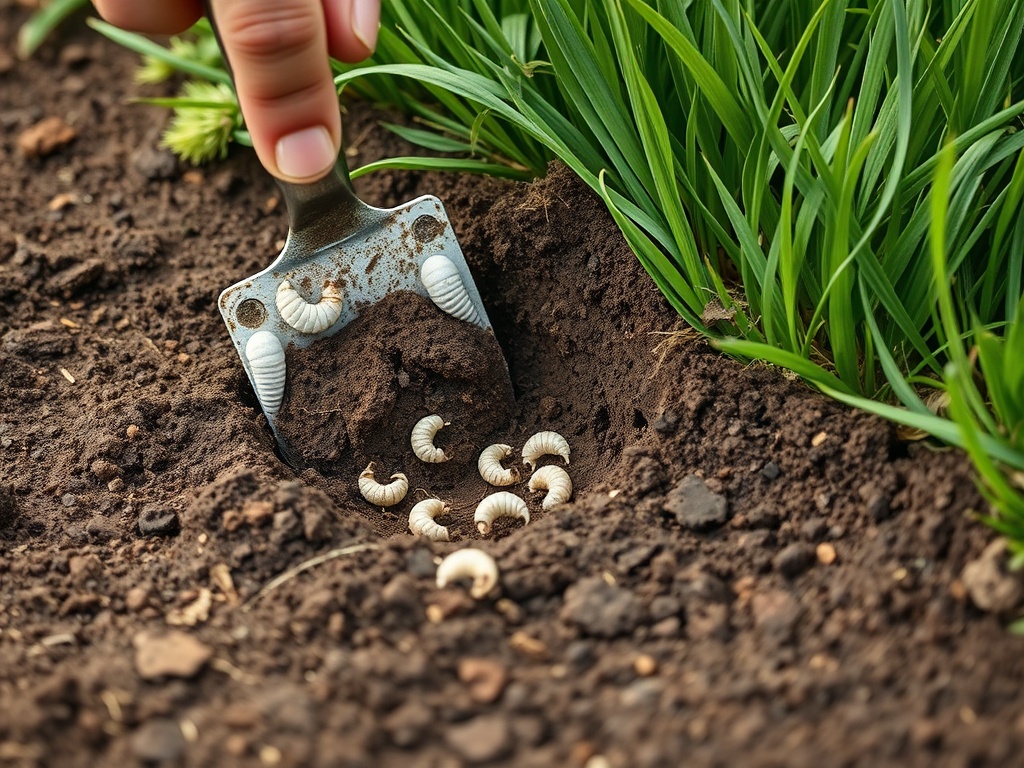
Examine soil and thatch for C-shaped white grubs. Check several representative spots rather than assuming one larva explains a large patch. If you cannot find meaningful grub activity, investigate irrigation, disease, compaction, or other insects before treating.
Grubs vs Drought at a Glance
| Diagnostic clue | More consistent with drought | More consistent with grubs |
|---|---|---|
| Browning pattern | Broad or exposure-related | Irregular patches may expand |
| Soil moisture | Root zone is notably dry | May be dry or adequately moist |
| Root attachment | Turf usually stays anchored | Root loss can make sod lift easily |
| Visible pest | None required | Grubs should be confirmed by sampling |
| Animal digging | Not a defining sign | Can occur where animals search for larvae |
| Best first response | Correct watering and reduce stress | Confirm infestation before selecting control |
This comparison is a diagnostic aid, not a guarantee. Turf problems frequently overlap, so the most reliable conclusion comes from multiple observations.
What to Do if Drought Is the Main Problem
Correct the irrigation problem instead of reacting with repeated shallow watering. The goal is to wet the active root zone without creating runoff, but exact timing and amount depend on grass species, soil, rainfall, climate, and local restrictions.
EPA WaterSense watering guidance recommends seasonal schedule adjustments, keeping water off pavement, repairing leaks and clogged heads, and using cycle-and-soak scheduling where water tends to pool or run off.
Reduce added stress during severe heat. Avoid aggressive renovation or unnecessary fertilization, mow with a sharp blade, and inspect sprinkler coverage. A dry strip beside a blocked head can look like pest damage. The same system check helps distinguish irrigation failure from a genuinely dry root zone.
What to Do if Grubs Are Confirmed
Confirm the grub species when possible and use local extension guidance because timing and recommended controls vary by region and life stage.
Do not apply a broad insecticide simply because one or two larvae are present. Consider larval numbers, root loss, turf condition, and local thresholds together. If a pesticide is appropriate, follow its label exactly. EPA’s read-the-label-first guidance explains that the label controls use sites, protective measures, storage, and application directions.
Cultural practices and, in some situations, biological controls can also be part of management. Their usefulness depends on the grub species, lawn condition, soil moisture, and local recommendations.
Cost and Maintenance: The Wrong Diagnosis Is the Expensive One
A misdiagnosis wastes both money and effort. Treating drought as grubs can mean buying pesticide without fixing irrigation; treating grub injury as drought can mean watering turf whose roots are disappearing.
Diagnosis is usually the lowest-cost first step: inspect moisture, lift turf, sample several spots, and compare the pattern with recent weather. If an application tool is eventually needed, review hand-pump, hose-end, and backpack sprayer basics so equipment choice does not add another source of error.
A Practical Decision Framework for the Brown Patch
Choose drought correction first when the soil is clearly dry, the roots remain attached, the damage follows heat or irrigation gaps, and you cannot find meaningful grub activity.
Choose grub management only after sampling confirms larvae and root injury is consistent with the damage. Then use local extension guidance and the pesticide label to select timing and treatment.
Choose professional or extension diagnosis when the soil is moist but turf is declining, patches keep spreading despite corrected watering, roots are intact, no grubs are found, or disease and other insects are plausible.
The goal is not to identify the lawn problem from one clue. It is to gather enough evidence that the remedy matches the cause.
Home and garden information is provided for educational purposes only. Pesticide choices, irrigation restrictions, and turf recommendations vary by product and location; follow labels, local rules, and qualified professional guidance where needed.[/